

Noorani Qaida Online Course
April 9, 2026
Reciting the Quran correctly requires more than recognizing Arabic letters and vowels. Each letter has a specific articulation point, sound quality, and relationship with the letters around it. Tajweed rules help Quran learners preserve these details and recite the words of Allah clearly, carefully, and respectfully.
For intermediate learners, the main challenge is usually not memorizing the names of the rules. It is recognizing them quickly and applying them naturally while reciting.
You may already know that Noon Sakinah can be pronounced with Izhar, Idgham, Iqlab, or Ikhfa. But can you identify the correct rule without pausing? Can you maintain the right Ghunnah while moving into the next letter? Can you apply Madd consistently without guessing?
This complete guide explains the major Quran Tajweed rules, their letters, practical application, common mistakes, and Quranic examples. It is designed to help you move from theoretical knowledge to more confident and accurate recitation.
Important note: This guide primarily follows the commonly taught Hafs ‘an ‘Asim recitation. Some details, particularly the length of certain forms of Madd, may differ across recognized Qira’at. Study with a qualified Quran teacher for direct correction and guidance.
What Is Tajweed?
The Arabic word Tajweed, written as تَجْوِيد, comes from a root carrying the meaning of improving, perfecting, or making something excellent.
In Quran recitation, Tajweed means pronouncing every letter from its correct articulation point while giving it its proper characteristics and applying the recitation rules connected to it.
In practical terms, Tajweed teaches you:
- Where each Arabic letter originates
- How heavy or light a letter should sound
- When a sound should be clear, hidden, or merged
- When nasalization is required
- How long a vowel should be extended
- Where to stop and where to continue
- How to avoid pronunciation errors that may affect a word
The Quran instructs believers to recite it in a measured and deliberate manner in Surah Al-Muzzammil, 73:4. Tajweed provides the practical framework through which learners develop that careful style of recitation.
Why Are Tajweed Rules Important?
Tajweed is not only about making recitation sound beautiful. Its primary purpose is to preserve the correct pronunciation of Quranic words.
Arabic letters may sound similar to an untrained learner, but they can have different articulation points and meanings. For example, س and ص are not interchangeable, nor are ح and ه. Replacing one with another can change the word being recited.
Tajweed also helps learners develop:
- Clearer Arabic pronunciation
- More consistent recitation
- Better control of breathing and pauses
- Greater confidence when reading aloud
- Stronger listening and self-correction skills
- A more attentive relationship with the Quran
However, reading about Tajweed cannot replace listening and guided practice. Tajweed is an oral discipline, and many pronunciation mistakes are difficult for students to hear in their own recitation. A trained teacher can identify subtle errors involving articulation, nasalization, heaviness, and timing.
The Foundations of Tajweed
Before studying individual rules, intermediate learners should strengthen two essential foundations: Makharij al-Huruf and Sifat al-Huruf.
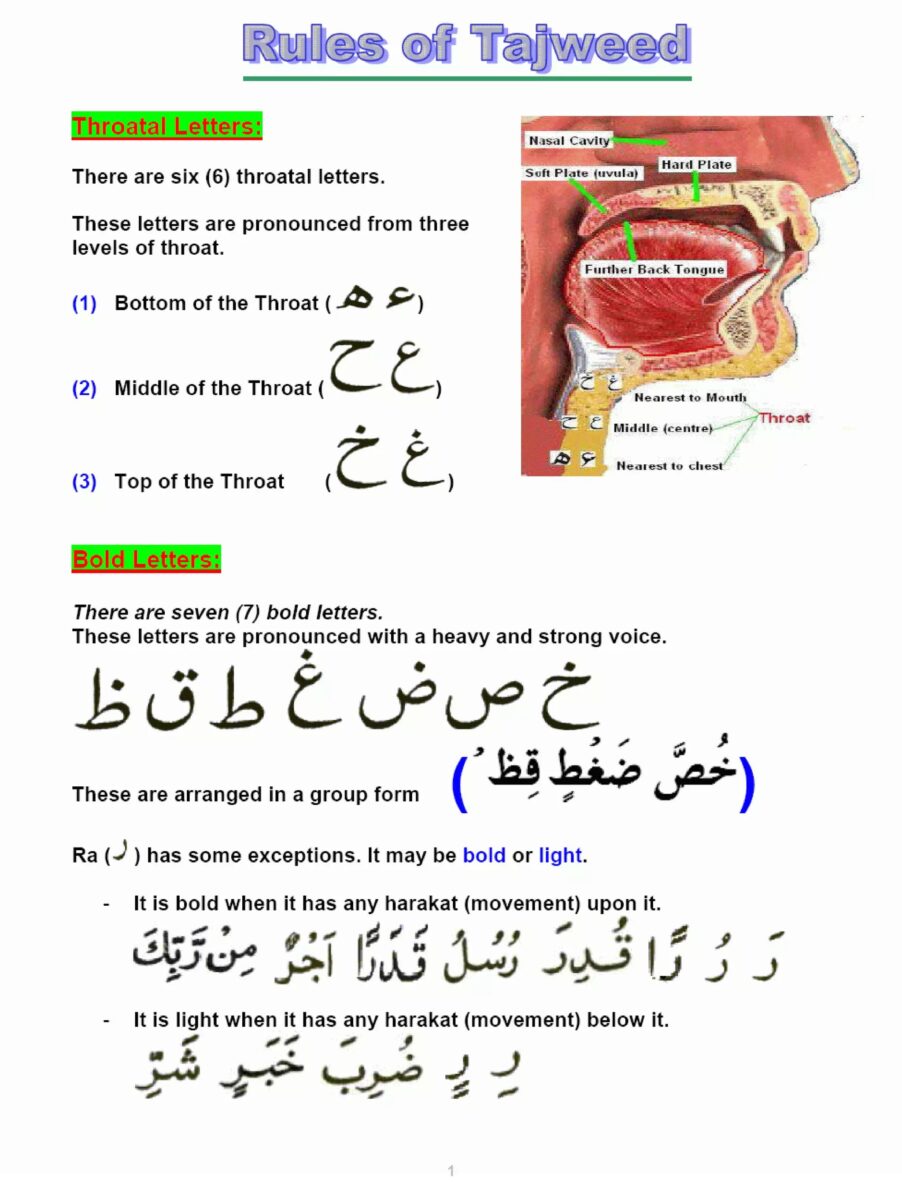
1. Makharij al-Huruf: Articulation Points
Makharij are the places from which Arabic letters are produced.
The main articulation regions include:
- The oral cavity
- The throat
- The tongue
- The lips
- The nasal passage
For example, the letters ء and ه originate from a different part of the throat than ع and ح. The letter ق is formed using the back of the tongue, while ك is produced slightly farther forward.
Knowing the rule attached to a letter is not enough when the letter itself is pronounced from the wrong place. This is why Makharij should be reviewed throughout a student’s Tajweed journey.
2. Sifat al-Huruf: Letter Characteristics
Sifat are the permanent or situational qualities of Arabic letters.
These characteristics explain why some letters sound:
- Heavy or light
- Strong or soft
- Whispered or voiced
- Continuous or restricted
- Elevated or lowered
For example, ص is naturally heavier than س, even when both carry the same vowel. Learning their characteristics helps prevent similar letters from blending into one another.
Rules of Noon Sakinah and Tanween
The rules of Noon Sakinah and Tanween are among the most frequently encountered Tajweed rules.
Noon Sakinah is a Noon carrying a Sukoon:
نْ
Tanween is the additional “n” sound found at the end of certain words:
- ً — an
- ٍ — in
- ٌ — un
The way Noon Sakinah or Tanween is pronounced depends on the letter that follows it.
There are four main rules:
- Izhar
- Idgham
- Iqlab
- Ikhfa
1. Izhar Halqi: Clear Pronunciation
Izhar means to make something clear.
Izhar occurs when Noon Sakinah or Tanween is followed by one of the six throat letters:
ء ه ع ح غ خ
When applying Izhar:
- Pronounce the Noon or Tanween clearly
- Do not merge it into the next letter
- Do not exaggerate the nasal sound
- Move cleanly from the Noon to the throat letter
Quranic example
أَنْعَمْتَ
In this word from Surah Al-Fatihah, the Noon Sakinah is followed by ع. The Noon must therefore be pronounced clearly before moving to the ‘Ayn.
Common mistake
Some learners add a long Ghunnah because they associate every Noon Sakinah with nasalization. In Izhar, the Noon remains clear and distinct without the prolonged Ghunnah used in Ikhfa or Iqlab.
2. Idgham: Merging
Idgham means merging one sound into another.
It occurs when Noon Sakinah or Tanween is followed by one of these six letters:
ي ر م ل و ن
These letters can be remembered through the word:
يَرْمَلُونَ
Idgham is divided into two types.
Idgham with Ghunnah
The letters of Idgham with Ghunnah are:
ي ن م و
They can be remembered through the word:
يَنْمُو
The Noon Sakinah or Tanween merges into the following letter while a nasal sound is maintained for approximately two counts.
Example
مَنْ يَعْمَلْ
The Noon Sakinah comes before ي, so the Noon merges into the Yaa with Ghunnah.
Idgham without Ghunnah
The letters are:
ل ر
When Noon Sakinah or Tanween appears before Laam or Raa, it merges without a prolonged nasal sound.
Example
مِنْ رَبِّهِمْ
The Noon Sakinah is followed by ر, so it merges into the Raa without Ghunnah.
Important exception
Idgham normally occurs between two separate words. When Noon Sakinah and an Idgham letter appear within the same word, the Noon may remain clear.
Examples include:
- الدُّنْيَا
- بُنْيَان
- صِنْوَان
- قِنْوَان
This is commonly described as Izhar Mutlaq, or absolute clarity.
3. Iqlab: Conversion
Iqlab means conversion or transformation.
It occurs when Noon Sakinah or Tanween is followed by only one letter:
ب
The Noon or Tanween sound changes into a concealed Meem sound with Ghunnah.
Quranic example
مِنْ بَعْدِ
Because Noon Sakinah is followed by Baa, it is recited with a concealed Meem sound, approximately like:
مِمْ بَعْدِ
The Meem is heard through nasalization, but it should not be pronounced as a completely separate, forceful Meem.
Common mistake
Do not close the lips too early or press them together forcefully. The conversion should remain smooth, with the Ghunnah leading naturally into the Baa.
4. Ikhfa Haqiqi: Concealment
Ikhfa means hiding or concealing.
It occurs when Noon Sakinah or Tanween is followed by any of these 15 letters:
ت ث ج د ذ ز س ش ص ض ط ظ ف ق ك
The Noon is not pronounced with complete clarity, nor is it fully merged. Its sound is partially concealed with Ghunnah for approximately two counts.
Example
مِنْ شَرِّ
The Noon Sakinah comes before ش, so it is concealed with Ghunnah.
How to improve your Ikhfa
Do not place the tip of the tongue in the complete Noon position. Instead, prepare the mouth for the letter that follows while allowing the nasal sound to continue.
The quality of Ikhfa changes slightly according to the following letter. Ikhfa before a heavy letter such as ق or ط has a heavier quality than Ikhfa before a light letter such as ت or ك. The rule remains Ikhfa, but the surrounding articulation affects its sound.
Rules of Meem Sakinah
Meem Sakinah is a Meem carrying a Sukoon:
مْ
It has three possible rules, depending on the letter that follows:
- Ikhfa Shafawi
- Idgham Shafawi
- Izhar Shafawi
The word Shafawi relates to the lips because Meem is pronounced using the lips.
1. Ikhfa Shafawi
Ikhfa Shafawi occurs when Meem Sakinah is followed by:
ب
The Meem is partially concealed with Ghunnah.
Quranic example
تَرْمِيهِمْ بِحِجَارَةٍ
The Meem Sakinah in تَرْمِيهِمْ is followed by Baa, so Ikhfa Shafawi is applied.
Avoid squeezing the lips together too firmly. The transition should remain controlled and natural.
2. Idgham Shafawi
Idgham Shafawi occurs when Meem Sakinah is followed by another Meem:
مْ + م
The first Meem merges into the second, producing a Meem with Shaddah and Ghunnah for approximately two counts.
Example
لَكُمْ مَا
The two Meems blend into one emphasized Meem sound.
3. Izhar Shafawi
Izhar Shafawi occurs when Meem Sakinah is followed by any letter other than:
- Meem
- Baa
The Meem should be pronounced clearly by closing the lips fully before moving to the next letter.
Extra care is needed before ف and و because these letters are also connected to the lips. Learners sometimes conceal the Meem accidentally instead of pronouncing it clearly.
Ghunnah in Noon and Meem Mushaddadah
Ghunnah is a nasal sound that resonates through the nasal passage.
When Noon or Meem carries a Shaddah, a complete Ghunnah is required:
- نّ
- مّ
Examples include:
- إِنَّ
- ثُمَّ
The Ghunnah is normally held for approximately two counts.
A useful self-check is to place a finger lightly beside the nose. You should feel nasal resonance, but the sound should not become strained or excessively long.
Ghunnah also appears in:
- Idgham with Ghunnah
- Ikhfa
- Iqlab
- Ikhfa Shafawi
- Idgham Shafawi
The strongest and most obvious Ghunnah is generally heard on Noon and Meem with Shaddah.
Madd Rules: Lengthening the Vowels
Madd means prolongation or lengthening.
The three Madd letters are:
- ا preceded by Fathah
- وْ preceded by Dammah
- يْ preceded by Kasrah
The number of counts depends on what appears before or after the Madd letter.
1. Madd Tabee‘i: Natural Madd
Madd Tabee‘i is the basic or natural prolongation.
It is held for two counts when the Madd letter is not followed by Hamzah or Sukoon.
Example
قَالَ
The Alif is lengthened for two counts.
This length should remain stable. A common intermediate-level problem is reading some natural Madd sounds for one count and others for three or four counts.
2. Madd Muttasil: Connected Madd
Madd Muttasil occurs when a Madd letter is followed by Hamzah in the same word.
Example
جَاءَ
In the commonly taught Hafs recitation, this Madd is generally extended for four or five counts, according to the method taught by the student’s teacher.
3. Madd Munfasil: Separated Madd
Madd Munfasil occurs when:
- A Madd letter appears at the end of one word
- Hamzah appears at the beginning of the next word
Example
فِي أَنْفُسِكُمْ
The Madd letter in فِي is followed by Hamzah in the next word.
Its length can vary according to the recognized recitation method being followed. Students should remain consistent with the method taught by their Quran teacher.
4. Madd Lazim: Necessary Madd
Madd Lazim occurs when a Madd letter is followed by a permanent Sukoon or a letter carrying Shaddah.
It is prolonged for six counts.
Quranic example
الضَّالِّينَ
The Alif is followed by a Laam carrying Shaddah, requiring six counts.
5. Madd ‘Arid Lil-Sukoon
This rule occurs when stopping on a word causes its final letter to receive a temporary Sukoon.
When a Madd letter appears before that temporary Sukoon, the learner may generally prolong it for:
- Two counts
- Four counts
- Six counts
Example
When stopping on:
الْعَالَمِينَ
the final Noon becomes temporarily silent, allowing the preceding Yaa Madd to be extended.
Whichever length is selected, it should be applied consistently within the same recitation passage.
6. Madd Leen
Madd Leen occurs when:
- Waw Sakinah or Yaa Sakinah is preceded by Fathah
- The reciter stops on the word
Examples include:
- خَوْف
- قُرَيْش
When stopping, it may be extended for two, four, or six counts, depending on the recitation method and context.
Qalqalah: The Echoing Sound
Qalqalah is a controlled bouncing or echoing sound produced when one of five letters carries Sukoon.
The Qalqalah letters are:
ق ط ب ج د
They can be remembered through the phrase:
قُطْبُ جَدٍّ
Levels of Qalqalah
Qalqalah Sughra
This occurs when the Qalqalah letter has an original Sukoon in the middle of a word.
Example:
يَقْطَعُونَ
The قْ receives a light bounce.
Qalqalah Kubra
This occurs when stopping on a Qalqalah letter at the end of a word.
Example:
الْفَلَقْ
The final Qaf receives a stronger bounce when stopping.
Qalqalah Akbar
Some teachers use this term for the strongest Qalqalah, which occurs when stopping on a Qalqalah letter carrying Shaddah.
Example:
الْحَقّ
Common mistake
Qalqalah should not become a full vowel.
For example, a silent Qaf should not be turned into “qa,” “qi,” or “qu.” The bounce must remain short, controlled, and connected to the original letter.
Tafkheem and Tarqeeq: Heavy and Light Letters
Tafkheem means pronouncing a letter with heaviness or fullness.
Tarqeeq means pronouncing a letter lightly.
The seven letters that are consistently heavy are:
خ ص ض غ ط ق ظ
They may be remembered through:
خُصَّ ضَغْطٍ قِظْ
The degree of heaviness can change according to the vowel on the letter, but these letters retain a heavy quality.
Most other Arabic letters are generally light, with important contextual rules for:
- Raa
- The Laam in the name of Allah
Rules of Raa
Raa may be heavy or light according to its vowel and surrounding letters.
Raa is generally heavy when:
- It carries Fathah
- It carries Dammah
- It has Sukoon and is preceded by Fathah
- It has Sukoon and is preceded by Dammah
Raa is generally light when:
- It carries Kasrah
- It has Sukoon and is preceded by an original Kasrah
Some Raa situations involve additional conditions, especially when letters of Isti‘la appear nearby. Intermediate and advanced learners should study these exceptions directly with a teacher.
The Laam in the Name of Allah
The Laam in اللَّه is pronounced heavily when preceded by Fathah or Dammah.
Example:
قَالَ اللَّهُ
It is pronounced lightly when preceded by Kasrah.
Example:
بِسْمِ اللَّهِ
These differences should be audible but natural. Avoid forcing the jaw or making the heavy sound overly deep.
Sun and Moon Letters
When the Arabic definite article ال appears before a noun, its Laam may be pronounced clearly or merged into the following letter.
Sun Letters
The 14 sun letters are:
ت ث د ذ ر ز س ش ص ض ط ظ ل ن
When ال comes before a sun letter, the Laam is not pronounced. It merges into the following letter, which receives emphasis.
Example:
الشَّمْس
Ghunnah in Noon and Meem Mushaddadah
Ghunnah is a nasal sound that resonates through the nasal passage.
When Noon or Meem carries a Shaddah, a complete Ghunnah is required:
- نّ
- مّ
Examples include:
- إِنَّ
- ثُمَّ
The Ghunnah is normally held for approximately two counts.
A useful self-check is to place a finger lightly beside the nose. You should feel nasal resonance, but the sound should not become strained or excessively long.
Ghunnah also appears in:
- Idgham with Ghunnah
- Ikhfa
- Iqlab
- Ikhfa Shafawi
- Idgham Shafawi
The strongest and most obvious Ghunnah is generally heard on Noon and Meem with Shaddah.
Madd Rules: Lengthening the Vowels
Madd means prolongation or lengthening.
The three Madd letters are:
- ا preceded by Fathah
- وْ preceded by Dammah
- يْ preceded by Kasrah
The number of counts depends on what appears before or after the Madd letter.
1. Madd Tabee‘i: Natural Madd
Madd Tabee‘i is the basic or natural prolongation.
It is held for two counts when the Madd letter is not followed by Hamzah or Sukoon.
Example
قَالَ
The Alif is lengthened for two counts.
This length should remain stable. A common intermediate-level problem is reading some natural Madd sounds for one count and others for three or four counts.
2. Madd Muttasil: Connected Madd
Madd Muttasil occurs when a Madd letter is followed by Hamzah in the same word.
Example
جَاءَ
In the commonly taught Hafs recitation, this Madd is generally extended for four or five counts, according to the method taught by the student’s teacher.
3. Madd Munfasil: Separated Madd
Madd Munfasil occurs when:
- A Madd letter appears at the end of one word
- Hamzah appears at the beginning of the next word
Example
فِي أَنْفُسِكُمْ
The Madd letter in فِي is followed by Hamzah in the next word.
Its length can vary according to the recognized recitation method being followed. Students should remain consistent with the method taught by their Quran teacher.
4. Madd Lazim: Necessary Madd
Madd Lazim occurs when a Madd letter is followed by a permanent Sukoon or a letter carrying Shaddah.
It is prolonged for six counts.
Quranic example
الضَّالِّينَ
The Alif is followed by a Laam carrying Shaddah, requiring six counts.
5. Madd ‘Arid Lil-Sukoon
This rule occurs when stopping on a word causes its final letter to receive a temporary Sukoon.
When a Madd letter appears before that temporary Sukoon, the learner may generally prolong it for:
- Two counts
- Four counts
- Six counts
Example
When stopping on:
الْعَالَمِينَ
the final Noon becomes temporarily silent, allowing the preceding Yaa Madd to be extended.
Whichever length is selected, it should be applied consistently within the same recitation passage.
6. Madd Leen
Madd Leen occurs when:
- Waw Sakinah or Yaa Sakinah is preceded by Fathah
- The reciter stops on the word
Examples include:
- خَوْف
- قُرَيْش
When stopping, it may be extended for two, four, or six counts, depending on the recitation method and context.
Qalqalah: The Echoing Sound
Qalqalah is a controlled bouncing or echoing sound produced when one of five letters carries Sukoon.
The Qalqalah letters are:
ق ط ب ج د
They can be remembered through the phrase:
قُطْبُ جَدٍّ
Levels of Qalqalah
Qalqalah Sughra
This occurs when the Qalqalah letter has an original Sukoon in the middle of a word.
Example:
يَقْطَعُونَ
The قْ receives a light bounce.
Qalqalah Kubra
This occurs when stopping on a Qalqalah letter at the end of a word.
Example:
الْفَلَقْ
The final Qaf receives a stronger bounce when stopping.
Qalqalah Akbar
Some teachers use this term for the strongest Qalqalah, which occurs when stopping on a Qalqalah letter carrying Shaddah.
Example:
الْحَقّ
Common mistake
Qalqalah should not become a full vowel.
For example, a silent Qaf should not be turned into “qa,” “qi,” or “qu.” The bounce must remain short, controlled, and connected to the original letter.
Tafkheem and Tarqeeq: Heavy and Light Letters
Tafkheem means pronouncing a letter with heaviness or fullness.
Tarqeeq means pronouncing a letter lightly.
The seven letters that are consistently heavy are:
خ ص ض غ ط ق ظ
They may be remembered through:
خُصَّ ضَغْطٍ قِظْ
The degree of heaviness can change according to the vowel on the letter, but these letters retain a heavy quality.
Most other Arabic letters are generally light, with important contextual rules for:
- Raa
- The Laam in the name of Allah
Rules of Raa
Raa may be heavy or light according to its vowel and surrounding letters.
Raa is generally heavy when:
- It carries Fathah
- It carries Dammah
- It has Sukoon and is preceded by Fathah
- It has Sukoon and is preceded by Dammah
Raa is generally light when:
- It carries Kasrah
- It has Sukoon and is preceded by an original Kasrah
Some Raa situations involve additional conditions, especially when letters of Isti‘la appear nearby. Intermediate and advanced learners should study these exceptions directly with a teacher.
The Laam in the Name of Allah
The Laam in اللَّه is pronounced heavily when preceded by Fathah or Dammah.
Example:
قَالَ اللَّهُ
It is pronounced lightly when preceded by Kasrah.
Example:
بِسْمِ اللَّهِ
These differences should be audible but natural. Avoid forcing the jaw or making the heavy sound overly deep.
Sun and Moon Letters
When the Arabic definite article ال appears before a noun, its Laam may be pronounced clearly or merged into the following letter.
Sun Letters
The 14 sun letters are:
ت ث د ذ ر ز س ش ص ض ط ظ ل ن
When ال comes before a sun letter, the Laam is not pronounced. It merges into the following letter, which receives emphasis.
Example:
الشَّمْس
It is pronounced approximately as ash-shams, not al-shams.
Moon Letters
The 14 moon letters are:
ا ب ج ح خ ع غ ف ق ك م و ه ي
Before a moon letter, the Laam is pronounced clearly.
Example:
الْقَمَر
It is pronounced al-qamar.
Waqf and Ibtida: Stopping and Starting Correctly
Waqf means stopping during recitation, while Ibtida means beginning or resuming.
Correct pronunciation alone is not enough if a reciter stops in a place that interrupts or distorts the meaning. Learners must therefore pay attention to the stopping symbols in the Mushaf.
Common signs include:
- مـ — stopping is required or strongly necessary
- لا — do not stop here
- ج — stopping or continuing is permissible
- قلى — stopping is preferred
- صلى — continuing is preferred
- س — pause briefly without taking a new breath
- ∴ ∴ — stop at one of the two locations, but not both
The exact explanation of some signs may vary slightly between printed Mushafs. Follow the notation guide provided in your copy of the Quran.
A technically correct stop may still be inappropriate when it separates words that belong together in meaning. This is why Tajweed should be studied alongside basic understanding of Quranic phrasing.
Common Tajweed Mistakes Intermediate Learners Make
Intermediate students often know the rules but struggle with consistency. Watch for these common problems:
1. Applying the rule too late
The mouth should prepare for the next letter before reaching it. Waiting until the final moment often produces an unnatural pause between the two sounds.
2. Making every Ghunnah identical
Ghunnah is affected by its context. The nasal quality before a heavy letter may not sound exactly like the quality before a light letter.
3. Turning Qalqalah into a vowel
A bounce is not an added Fathah, Kasrah, or Dammah. Keep it short and controlled.
4. Guessing the Madd length
Do not lengthen according to emotion or melody alone. Count consistently and follow the recitation method taught by your teacher.
5. Making heavy letters excessively heavy
Tafkheem requires elevation and fullness, not shouting or unnecessary pressure in the throat.
6. Neglecting Makharij while focusing on rules
Perfect Ikhfa cannot correct a Qaaf pronounced like Kaaf. Letter articulation remains the foundation of every Tajweed rule.
7. Running out of breath at unsuitable places
Plan your breath before beginning a long verse. Read the phrase first, identify a suitable stopping point, and then recite.
8. Reading too quickly
Speed often causes learners to shorten Ghunnah, miss Madd, weaken Shaddah, and merge letters incorrectly.
How to Improve Your Tajweed as an Intermediate Learner
Knowing more rules does not always produce better recitation. Focused correction is often more effective than studying several new topics at once.
Use this five-step practice method
Step 1: Select a short passage
Choose three to five verses rather than an entire page.
Step 2: Mark the rules
Identify:
- Noon Sakinah and Tanween
- Meem Sakinah
- Ghunnah
- Madd
- Qalqalah
- Heavy and light letters
- Suitable stopping points
Step 3: Listen to a skilled reciter
Listen several times while following the Mushaf. Focus on one feature during each repetition, such as Madd length or Ghunnah.
Step 4: Record your recitation
Recite the same verses and record yourself. Compare your timing, articulation, and pauses with the model recitation.
Step 5: Recite to a qualified teacher
Ask for specific correction rather than general feedback. For example:
- Is my Ikhfa too clear?
- Is my Raa heavy in the correct places?
- Am I holding Madd Lazim for six complete counts?
- Is my Qalqalah turning into a vowel?
This creates a measurable practice goal for the next session.
A simple weekly Tajweed routine
A productive routine may include:
- Day 1: Makharij and difficult letters
- Day 2: Noon Sakinah and Tanween
- Day 3: Meem Sakinah and Ghunnah
- Day 4: Madd timing
- Day 5: Tafkheem, Tarqeeq, and Raa
- Day 6: Waqf and full-passage recitation
- Day 7: Teacher feedback and revision
Regular, focused practice is more beneficial than occasional long sessions.
Frequently Asked Questions About Tajweed Rules
What are the main rules of Tajweed?
The main areas include Makharij, letter characteristics, Noon Sakinah and Tanween, Meem Sakinah, Ghunnah, Madd, Qalqalah, heavy and light letters, rules of Raa and Laam, and correct stopping and starting.
How many Tajweed rules are there?
There is no single universally accepted number because Tajweed can be organized into broad categories or divided into detailed sub-rules. Some courses present a small number of main subjects, while advanced texts divide them into many individual cases.
Can I learn Tajweed by myself?
You can learn terminology, identify rules, listen to reciters, and practice independently. However, self-study alone may not reveal subtle pronunciation errors. Regular correction from a qualified teacher is strongly recommended because Tajweed is learned through listening, imitation, and direct feedback.
What is the difference between Tajweed and Tarteel?
Tajweed refers to the pronunciation principles and rules applied during recitation. Tarteel refers to reciting in a measured, clear, and deliberate manner. A reader uses Tajweed while reciting with Tarteel.
What is the difference between Tajweed and Qira’at?
Tajweed governs how Quranic letters and words are pronounced correctly. Qira’at are the recognized transmitted modes of Quranic recitation. Tajweed is applied within each accepted Qira’ah, although certain details may differ between them.
How long does it take to learn Tajweed?
The time required depends on the learner’s Arabic reading ability, current pronunciation, lesson frequency, practice routine, and access to qualified feedback. Students may understand the basic rules relatively quickly, but applying them naturally and consistently requires sustained practice.
Which Tajweed rules should intermediate learners study first?
Intermediate learners should strengthen Makharij before reviewing Noon Sakinah, Meem Sakinah, Ghunnah, Madd, Qalqalah, Tafkheem, Tarqeeq, and stopping rules. The best order depends on the mistakes present in the learner’s recitation.
Can Tajweed be learned online?
Yes. Live online lessons can be effective when the teacher listens carefully, demonstrates the correct sound, and provides immediate individual feedback. Recorded lessons are useful for revision but should not be the only source of pronunciation correction.
Continue Improving Your Quran Recitation
Mastering Tajweed is not achieved by memorizing definitions alone. Real progress appears when correct pronunciation becomes consistent during continuous recitation.
Focus on one weakness at a time. Listen attentively, recite slowly, record yourself, and seek regular feedback from a qualified teacher. With patient practice, the rules that once required conscious effort can gradually become a natural part of your Quran recitation.
At [Academy Name], our [qualified/certified] Quran teachers provide structured Tajweed lessons for learners who want to correct persistent mistakes, strengthen their pronunciation, and recite with greater confidence.
[Book a Trial Class] to receive personal feedback on your Quran recitation and a learning plan based on your current level.
E-E-A-T PUBLISHING ELEMENTS
Add the following details before publishing:
Written by:
[Teacher or Author Name], [relevant qualification and years of teaching experience]
Reviewed by:
[Qualified Tajweed Teacher’s Name], holder of Ijazah in [Hafs ‘an ‘Asim or relevant Qira’ah]
Last reviewed:
[Month and year]
Editorial note:
This article provides educational guidance and follows the Hafs ‘an ‘Asim recitation unless otherwise stated. Learners should consult a qualified Quran teacher for personal pronunciation correction.
RECOMMENDED INTERNAL LINKS
Link relevant phrases in the article to:
- Online Tajweed course
- Quran recitation classes
- Learn Quran online
- Quran classes for adults
- Quran classes for children
- Arabic pronunciation guide
- What is an Ijazah?
- How to improve Quran recitation
- Noorani Qaida course
- Free trial Quran class
RECOMMENDED VISUALS
- Diagram showing the major Makharij regions
- Noon Sakinah and Tanween rule chart
- Meem Sakinah decision diagram
- Madd types and count comparison graphic
- Qalqalah letters infographic
- Heavy and light Arabic letters chart
- Mushaf stopping-symbol reference image
- Short teacher demonstration videos or audio clips
